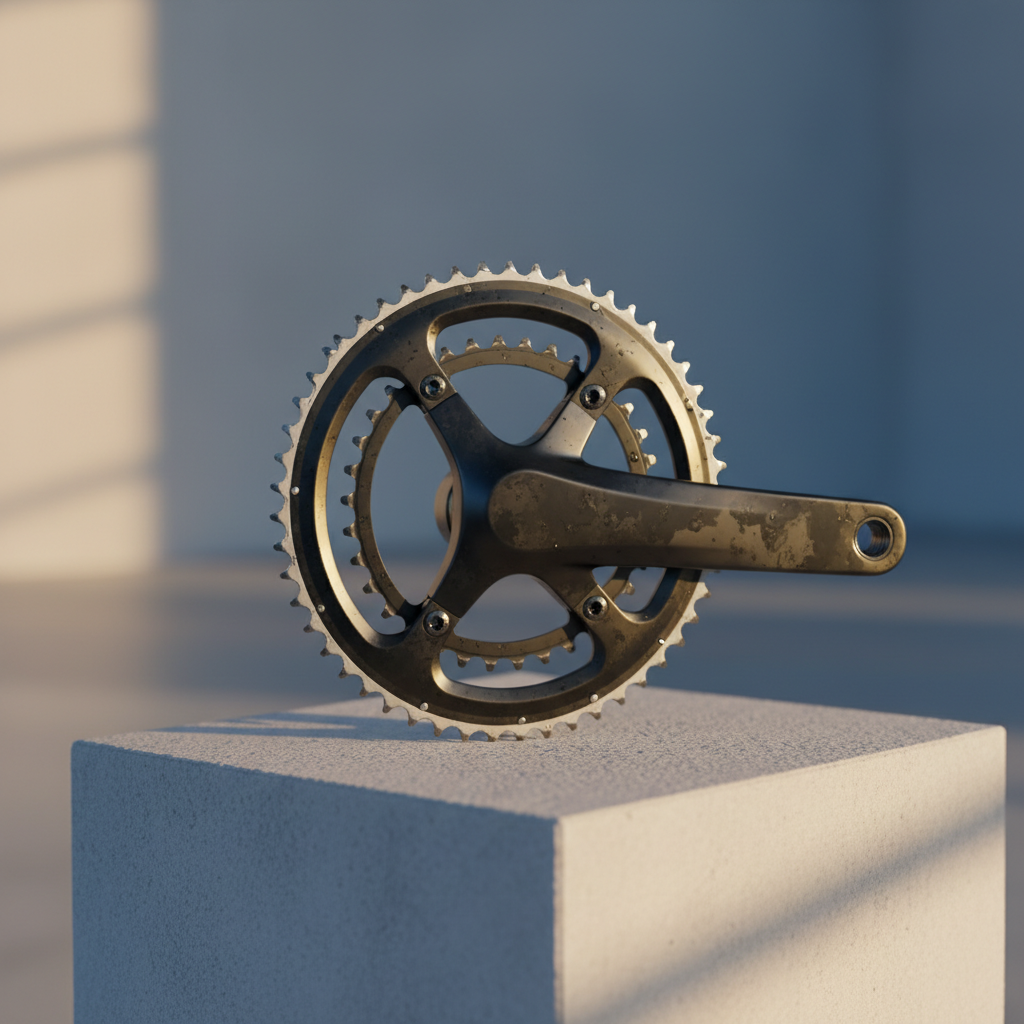
Choosing the Right Chainring for Zwift
Zwift’s internal testing and support documentation suggest that for most workouts and general riding, the small front ring provides a superior experience.
Flywheel Speed: Using the small ring keeps your trainer’s flywheel spinning at a lower speed. This reduces noise and vibration, making it friendlier for apartment living.
Faster Resistance Changes: Most smart trainers respond more quickly to gradient changes or interval transitions when the flywheel is moving slower.
The "Feel" of Climbing: Low flywheel speed better mimics the high-torque feeling of real-world climbing. If you use the big ring on a climb, the momentum of the flywheel can make it feel like you're being "pushed" up the hill, which isn't as effective for training.
Choosing Your Chainring Setup
Even though you’ll be spending more time in the small ring, your crankset choice still matters for those moments when you do need to shift up.
The Compact (50/34): The gold standard for Zwift. The 34t inner ring allows you to keep your cadence high (85–95 RPM) on steep sections like the Radio Tower or Alpe du Zwift.
The Mid-Compact (52/36): Best for high-wattage riders. If your FTP is over 300W, a 36t small ring provides enough resistance to keep you in the middle of your cassette during steady-state zone 2 rides.
The 1x Setup (40t - 44t): The ultimate "small ring" philosophy. By removing the front derailleur entirely, you simplify your drivetrain. Just be aware that without a big ring, you may "spin out" (lose resistance) on descents exceeding -8% if your trainer difficulty is set high.
The "Trainer Difficulty" Factor
Zwift’s Trainer Difficulty setting (defaulted at 50%) acts like a virtual gear multiplier.
At 50% Difficulty: A 10% grade feels like a 5% grade. This allows you to stay in your small ring comfortably even on the steepest mountains.
At 100% Difficulty: You feel every bit of the incline. If you plan to ride at 100% realism, the smallest possible front ring (like a 34t) is almost mandatory to avoid "grinding" your knees into dust on the 15% ramps of the Ventoux.
Pro-Tip: The "Straight Chainline"
The secret benefit of using your small ring is the chainline. By staying in the small ring and using the middle of your cassette, your chain stays straight. This reduces friction, saves wear and tear on your expensive drivetrain, and is significantly quieter than "cross-chaining" in the big ring.
Summary: Don't be afraid of the small ring. It offers better trainer responsiveness, less noise, and a more realistic climbing feel. Save the big ring for the final 500 meters of a race or when you're trying to clock a PR on a descent.