
This is why your inflated FTP is killing your progress
Have you ever finished a threshold interval session feeling like you were fighting for your life? Your legs felt like concrete, your heart rate kept climbing despite steady power, and you were gasping for air long after the effort stopped.
You might have looked at your power meter and thought: "I hit the numbers, so it must be a good workout."
But physiology tells a different story. If you are digging that deep for a "threshold" workout, you likely aren't training your aerobic engine—you are merely draining your anaerobic battery.
This guide explores the science of Lactate Dynamics, Heart Rate Decoupling, and Power Duration Curves to help you identify if your FTP is set too high and how to find your true physiological baseline.
1. The Symptom: 12 mmol/L at "Threshold"
Let's look at a common scenario: A rider performs 3 intervals at 245 watts. They believe this is their Functional Threshold Power (FTP). However, a lactate test immediately after the effort shows a concentration of 12.1 mmol/L.
To put that in perspective:
Aerobic Threshold (Zone 2): Typically < 2.0 mmol/L.
Anaerobic Threshold (FTP): Typically ~4.0 mmol/L.
Anaerobic Capacity (VO2 Max/Sprints): > 8.0 mmol/L.
The Diagnosis:
Hitting 12.1 mmol/L during a sustained effort means the rider was not in a "steady state." They were riding significantly above their threshold, relying heavily on glycolysis (burning sugar without oxygen). While the power meter said "Zone 4," the body was screaming "Zone 5/6."
This results in accumulated fatigue, massive hormonal stress (cortisol), and a training stimulus that builds anaerobic tolerance rather than aerobic endurance.
2. The Lie of the Ramp Test (and VLamax)
Why do so many riders train at a wattage that is simply too high? The culprit is often the Ramp Test or short 20-minute tests.
If you have a high VLamax (a high rate of lactate production, meaning you are punchy/explosive), you can "cheat" these tests. You can suffer through the final minutes using anaerobic power, inflating your estimated FTP.
The Power Curve "Cliff"
A tell-tale sign of an overestimated FTP is the shape of your Power Duration Curve.
The Plateau: You can hold 245W for 8–12 minutes comfortably.
The Cliff: Suddenly, past the 15-minute mark, your sustainable power drops strictly to 210W.
If your power drops by ~30-40 watts when the duration extends beyond the capacity of your anaerobic battery, the lower number (210W) is your true FTP. The higher number (245W) is simply your aerobic engine boosted by a turbocharger that runs out of gas quickly.
3. Decoupling: The Truth Serum
Since we cannot prick our fingers for lactate during every ride, we use Heart Rate Decoupling (Pw:HR) as our daily lie detector.
Decoupling measures the "drift" between your Power (external load) and Heart Rate (internal cost).
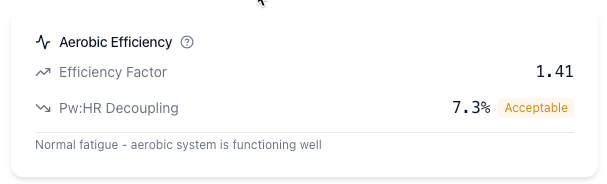
Did you know: You can see decoupling in every activity in FTPist.com:
What to Look For
Ideally, if you ride at a steady power, your heart rate should remain relatively steady (after the initial warm-up).
< 5% Decoupling: Excellent aerobic fitness. You are durable.
5–8% Decoupling: Borderline. Acceptable for very long rides, but indicates fatigue.
> 8% Decoupling: The "Red Flag." You are riding above your durability limit.
Micro-Analysis: Interval Drift
Don't just look at the ride summary. Look at the drift within or between intervals.
Interval 1: Avg HR 155 bpm.
Interval 4: Avg HR 165 bpm (at the same watts).
Verdict: This is classic Cardiac Drift. Your body is overheating, recruiting fast-twitch fibers, and struggling to clear metabolites. You are no longer training the targeted energy system.
4. The Hidden Variable: Fueling and Hydration
Physiology doesn't happen in a vacuum. Your numbers can be drastically skewed by what you eat and drink.
The "Empty Tank" Phenomenon:
Attempting high-intensity intervals on a caloric deficit (e.g., only consuming 850 kcal by 5:00 PM) is a recipe for disaster.
High RPE: It feels harder than it is.
High Cortisol: Stress hormones spike.
Dehydration: Low glycogen means low water retention. Thick blood increases heart rate and lactate concentration.
The Fix:
Hydration: 500-750mL fluid per hour of intense exercise.
Carbs: Fuel the work. Ensure glycogen stores are topped up 3 hours before intensity.
5. The Solution: Clearance & Calibration
So, you realized your FTP is set too high. How do you fix it and get faster?
Step 1: The Clearance Test
Evidence of a good aerobic engine is not just how much power you produce, but how fast you recover.
Protocol: After a hard effort (high lactate), ride at low intensity (Zone 1 / ~120W) for 10 minutes.
Good Result: Lactate drops from >10 mmol/L to <3 mmol/L.
This confirms your baseline aerobic system is actually healthy—you just need to stop drowning it in acid during intervals.
Step 2: Find Your "Balance Point"
Stop training at the number you want to hit, and train at the number your physiology can support.
Perform a long steady-state test (30–40 minutes).
Your FTP is the power you can sustain where Heart Rate remains stable (does not drift endlessly).
For the profile discussed above, dropping from 245W to 210–215W would likely result in higher quality training, lower stress, and better long-term gains.
The Recovery Paradox: When Decoupling Lies
You might upload a super easy recovery ride—a session where you barely broke a sweat—and look at the analytics only to see a massive decoupling (sometimes >10%).
The light blue curve on your graph skyrockets at the end, even though you felt fine. Did you lose all your fitness overnight? No.
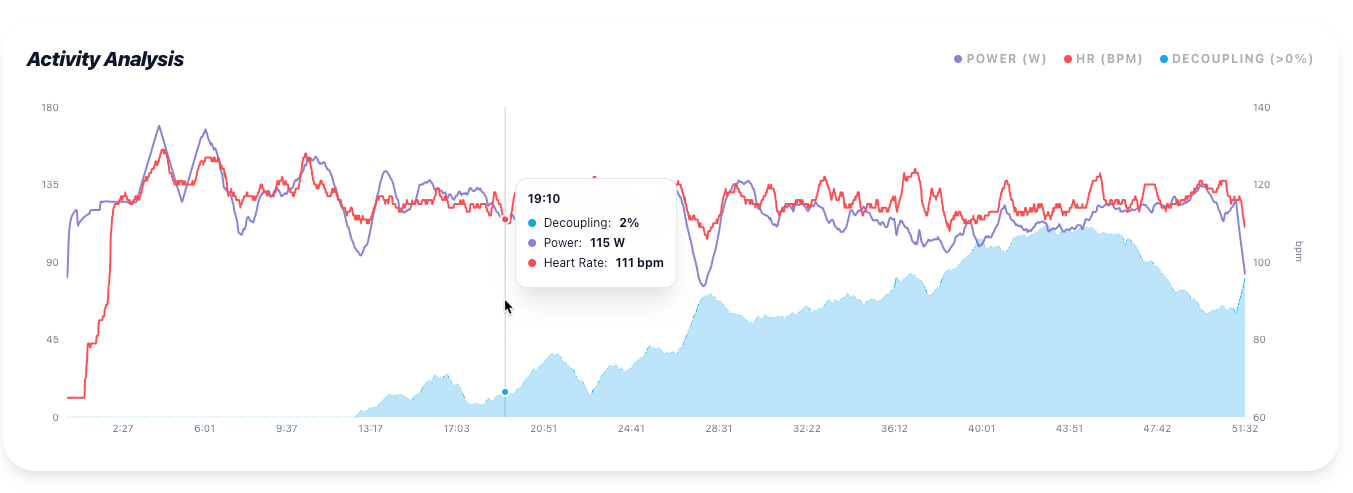
In Zone 1 (Recovery) and lower Zone 2, decoupling is notoriously unreliable. Here is why your data looks "bad" even when your ride was perfect:
1. The "Heart Rate Floor"
Heart rate does not scale linearly all the way down to zero.
If you ride at 200 watts, your heart might beat at 140 bpm.
If you drop the power by 50% to 100 watts, your heart rate won't drop by 50% to 70 bpm. It might only drop to 110 bpm.
Your body has a "floor"—a baseline heart rate required just to move your legs, keep you upright, and function.
The Math Problem: Decoupling software looks at the ratio of Power to Heart Rate. Because your power dropped significantly (e.g., during a cool down) but your heart rate hit its "floor" and stayed stable, the software thinks you became inefficient.
2. The Thermal Drift
Even at low intensity, your body temperature rises slightly over an hour, especially indoors.
Your heart beats a few times faster per minute to send blood to the skin for cooling.
At 250 watts, a 5-beat drift is a tiny percentage.
At 100 watts, a 5-beat drift is a huge percentage relative to the power. The algorithm flags this as a major loss of efficiency, even though it’s just normal thermoregulation.
3. The "Soft-Pedal" Effect
On recovery rides, we often vary our cadence or soft-pedal.
If you stop pedaling for 10 seconds, your power is 0, but your heart rate is still 100+.
This destroys the Power:HR ratio for that segment. If your ride has a lot of coasting or soft-pedaling (which recovery rides should!), your decoupling numbers will look terrible.
The Verdict?
Context is King.
Zone 3, 4, and Sweet Spot: Decoupling is the Holy Grail. Trust it.
Zone 1 and Recovery: Ignore it.
If you see high decoupling on a recovery ride, but your RPE (Rate of Perceived Exertion) was low and you feel better than when you started—congratulations, you nailed the workout. The data is just a mathematical artifact.
Summary: Train Smarter, Not Harder
Raising your FTP isn't about smashing yourself against a wall of 12 mmol/L lactate three times a week. It's about raising the floor.
By lowering your interval intensity to your true physiological threshold (where lactate is steady ~4 mmol/L and decoupling is <5%), you build the mitochondrial density required to eventually turn those 245 watts from a painful 5-minute effort into a sustainable 40-minute cruise.
Respect the data. Trust the process. Fuel the engine.